There’s been a lot of back-and-forth lately about which AI is best for doing homework or, let’s be real, even for cheating on exams. All this debate got me thinking: as AI keeps getting better and older models become outdated almost overnight, are we actually in the middle of a massive AI breakthrough, or are we just inflating an AI bubble that’s bound to pop? In this post, I’m diving into that question while exploring how the tech market’s current trends could hint at a growing recession risk beneath all the hype.
Human evolution has always been driven by growth and innovation, and every few decades, the market falls in love with revolutionary technologies that promise to reshape the world. In the late 1990s, it was the internet. In the mid-2000s, it was housing and credit derivatives. Today, it’s artificial intelligence. From assisting with schoolwork to optimizing financial trading algorithms, AI has slowly integrated itself into our lives. But is the market accurately pricing the impact AI will have?
Understanding Economic Bubbles
An economic bubble occurs when asset prices surge beyond their intrinsic value, typically driven by speculation or breakthrough technologies, before experiencing a sharp correction. This happens because markets become overoptimistic about an asset's true worth. Currently, investors are increasingly bullish on artificial intelligence and its potential market impact.
Economic Bubbles typically follow a pattern:
- Innovation Trigger: Introduction of new technology
- Early Adoption: Smart Capital Flows in
- Mania Phase: Retail investors join the buying spree
- Reality Check: Profit and growth slow down
- Collapse: Revaluation of the market
The stock market is sitting near all-time highs right now, but if you dig deeper, the economic signals are pretty mixed and honestly, some of them are kind of concerning. I think we can get a clearer picture of what's actually going on by looking at four key pillars: growth, inflation, interest rates, and liquidity. These give us a better sense of the macro environment we're dealing with.
Historically, before a recession occurs, certain economic indicators tend to follow identifiable trends that signal a possible downturn. To assess whether the market may follow a similar trajectory, we can turn to one of the market’s most respected valuation metrics for guidance.
The Shiller Price-to-Earnings Ratio
A key indicator used to evaluate the pricing of assets in the market is known as the Shiller Price-to-Earnings Ratio. The ratio compares the current price of a stock index, typically the S&P 500, to the average of its inflation-adjusted earnings over the past ten years.
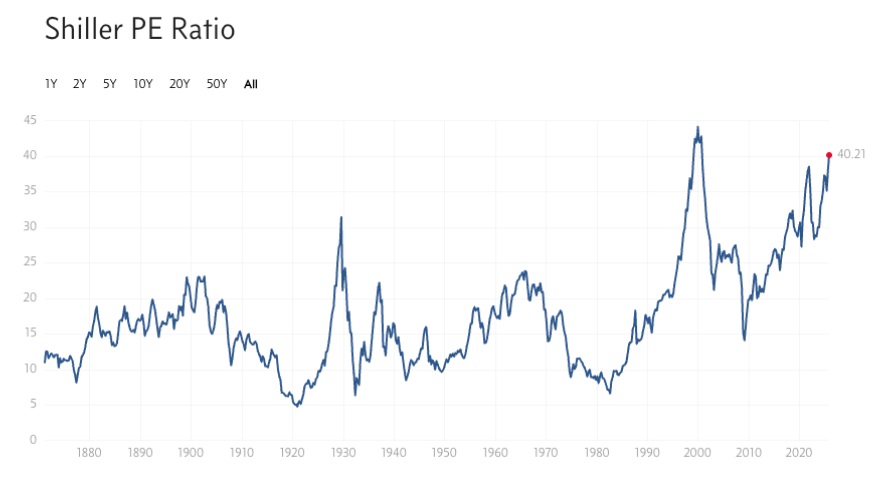
On average, the Shiller P/E ratio should trade at 15x value for a fairly valued market where you as a retail investor benefit from capital gains in the long-term. Currently, the S&P 500 is trading at a 40.21 Shiller P/E Ratio, surpassing its value during the 2008 mortgage crisis and the 2020 pandemic. This current value is a warning signal of an inflated stock market, reflecting an eerily familiar pattern of optimism and overvaluation.
Supply Chain Vulnerabilities
Tariffs and Chip Manufacturing
A major bottleneck is brewing in terms of the supply of GPUs and advanced semiconductors critical to AI development. The machinery and expertise needed to manufacture cutting-edge chips are concentrated among a few firms, require heavy capital investment, and pristine conditions that would take years to replicate.
Given the growing tensions with China, the leading manufacturer, TSMC (Taiwan Semiconductor Manufacturing Company), is subject to ongoing geopolitical uncertainty, creating a sector-wide liability. The second-largest manufacturer, Samsung, has been unable to match TSMC’s yield rates and efficiency in large-scale production. NVIDIA had previously considered Samsung, but the company experienced a 20% performance and yield loss, leading it to revert to TSMC. This highlights TSMC’s irreplaceable role in the global AI supply chain.
Trade Tensions Impact
Trade tensions between the United States and China are another factor that could impact the industry. Companies like NVIDIA and AMD rely heavily on Chinese and Taiwanese supply chains for fabrication, assembly, and rare-earth inputs. As tariffs rise on Chinese imports, the cost for GPU manufacturing increases, minimizing profit margins and raising end-user prices. China dominates the global supply of key minerals such as gallium, germanium, and rare earth elements, essential for chip production.
Valuations and Concentration
The $21 Trillion Question
Since the launch of OpenAI’s ChatGPT in 2022, the U.S. stock market’s valuation has gone up by $21 trillion. Remarkably, just ten companies, including Amazon, Broadcom, and NVIDIA, account for 55% of this gain. This intense concentration poses a significant risk; a market bubble will only emerge if AI’s returns fail to meet these lofty expectations.
History Rhyming: Dot-Com 2.0
At the peak of the dot-com bubble, tech stocks made up roughly 35% of the S&P 500, with many trading at P/E ratios exceeding 80x despite weak profits. Today, the so-called “Magnificent Seven” (Apple, Amazon, Google, Meta, Microsoft, Nvidia, and Tesla) now represent over 34% of the S&P 500’s total value, with Nvidia alone accounting for nearly 8%.
This degree of market concentration introduces systemic risk: if AI’s economic returns fall short of investor expectations, the broader market could face significant downward repricing.
The Bubble-Up Phase
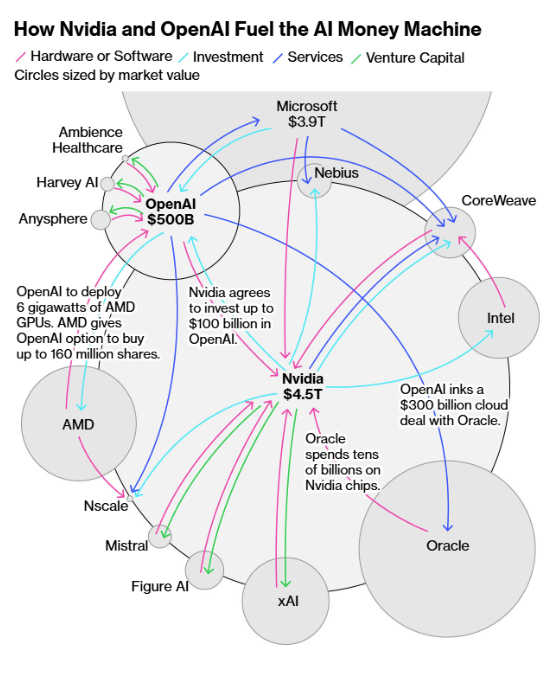
From an econometric perspective, this environment aligns with the “bubble up” phase—periods of rapid price escalation fueled by optimism and interlinked profit expectations. The AI sector’s valuations are driven primarily by narrative and network effects, not by fundamentals like earnings growth or macroeconomic balance. The heavy clustering of AI profits signals a speculative concentration risk.
The AI Paradox: Investment vs. Returns
Before you start investing, the first essential lesson is understanding that markets follow patterns, and a fundamental rule is that markets tend to repeat themselves. Currently, we are witnessing striking similarities between today’s market conditions and those that preceded past recessions.
Historically, equity investments have been grounded in strong fundamentals. Today’s market, however, is driven by intense retail momentum and fear of missing out (FOMO). Widespread availability of zero-brokerage accounts enables many investors to pour money into tech giants without adequate financial knowledge.
Investment in AI infrastructure is expected to reach $375 billion in 2025 and rise to $500 billion in 2026. Other projections expect infrastructure investments will total around $7 trillion over the next decade. However, the development of AI infrastructure does not yield immediate returns. Much like the fiber optic network established before the Dot-Com bubble, it is a slow process aimed at laying the groundwork for long-term growth.
Evidence is piling up that AI is failing to deliver in the real world yet; tech giants are nowhere close to recouping their investments. Determining a company’s intrinsic value requires thorough analysis, a task many retail investors lack the time or expertise to perform. With continuous inflows into companies that may not deliver proportional returns, the market could be headed for a precarious situation.
References
- ATSIWO, A. (2025, November 8). A THREE-STEP MACHINE LEARNING APPROACH TO PREDICT MARKET BUBBLES WITH FINANCIAL NEWS. Link
- CNBC. (2025, March 18). Nvidia announces Blackwell Ultra and Rubin AI chips. Link
- The Economist. (2025, September 7). What if the AI stockmarket blows up? Link
- JP Morgan Private Bank. (2025, November 8). Five factors we use to track recession risk, and what they say now. Link
- Multpl. (2025, October 30). Shiller PE Ratio. Link
- Sage Economics. (2025, October 14). Is Data Center Construction Overhyped? Link
- Seeking Alpha. (2025, October 17). AMD: Since When Have Integrated Supply Chains Become A 'Bubble'? Link
- Brookfield. (2025, August 1). Building the Backbone of AI. Link