Peloton’s reputation has been through all the seasons: cult hardware brand, lockdown rocket ship, post-COVID hangover, and then the “busted bike company” meme. That story’s stale. The current version is quieter and better: The company that overbuilt inventory now makes its money on a $55 habit with software-like margins; the hardware is just the on-ramp. I’ll deconstruct the name using my 3-stage framework: how the business really makes money, what’s actually moving the stock, and the trade setups that matter. Then we’ll land on a straight bull/base/bear with the math to back it.
Stage 1: Analyzing the Business
The core drivers of the industry
At-home fitness only works when you’re selling a habit, not a hunk of metal. Peloton’s mix tells the story: in FY25, it did $2.49B of revenue, with roughly $1.67B coming from subscriptions and about $0.82B from hardware. In plain English, the bike is the on-ramp; the monthly plan is the product and the profit pool.
The core drivers of the business
At-home fitness only works when you’re selling a habit, not a hunk of metal. Peloton’s mix tells the story: in FY25, it did $2.49B of revenue, with roughly $1.67B coming from subscriptions and about $0.82B from hardware. In plain English, the bike is the on-ramp; the monthly plan is the product and the profit pool.
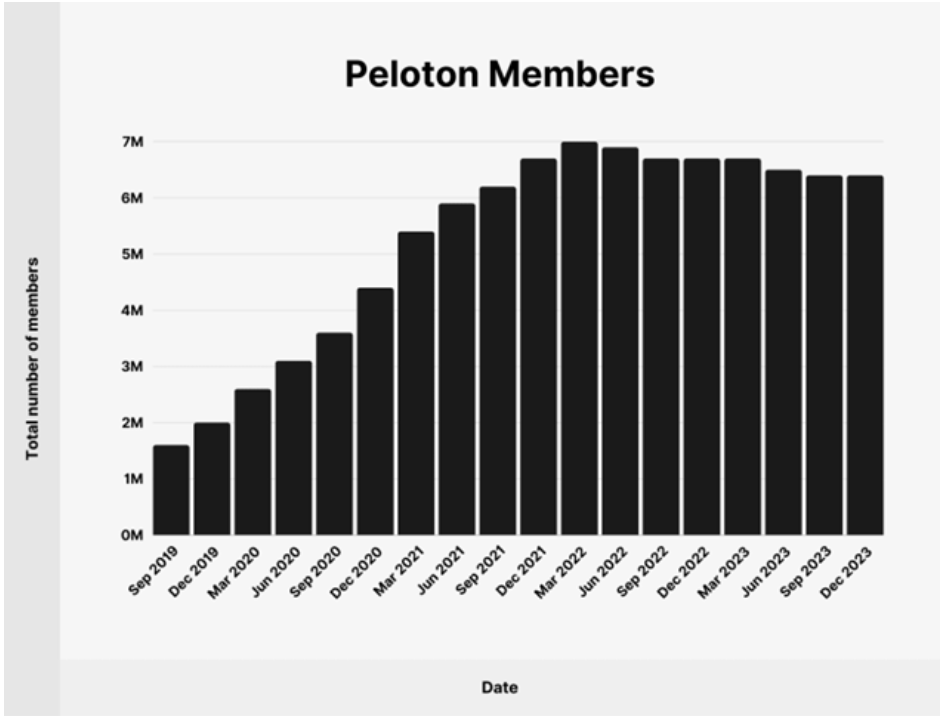
For investors, the levers are simple and measurable: how many members you have, how often they show up, and how long they stick. Peloton ended FY25 with ~2.8M paid Connected Fitness subs who average ~13 workouts per account per month. Keep that usage high and monthly churn ~1.6% stays contained, which supports the software-like unit margins already visible in the model (~69% subscription GM, ~73% contribution). That’s why the more dependable, higher-margin cash flow sits with the subscription, not the hardware.
Unit economics
Let’s put real numbers on the habit. The All-Access plan is $55/month. After costs, Peloton keeps about ~69%, so roughly ~$38 of gross profit per member per month. Members are fairly sticky: ~1.6% monthly churn implies ~63 months of average life. Do the napkin math and you get ~$2.4–$2.5k in gross-profit LTV per Connected Fitness sub.
You can see that math shows up in the FY25 results: Adjusted EBITDA ~$404M and Free Cash Flow ~$324M. Hardware pulled its weight at ~$817M revenue, but mainly as the on-ramp — it recruits members; the subscription turns them into cash. Stack a few million long-lived, high-margin memberships, keep engagement up and churn contained, and the P&L behaves like software without needing a hardware rebound.
Stage 2: Understanding the Stock
What has moved the stock recently vs. historically
Peloton’s share price used to trade on the COVID boom/bust: a demand spike, then recalls and inventory pain, then the lazy “it’s just a bike” label. That phase ended when the cash register turned on. In FY25, operating expenses fell from about $1.74B to $1.30B, loss from operations tightened to roughly –$36M, and cash flipped positive — CFO ~$333M and FCF ~$324M. Those prints matter more than any tweet. Once the model started throwing off cash, the narrative followed.
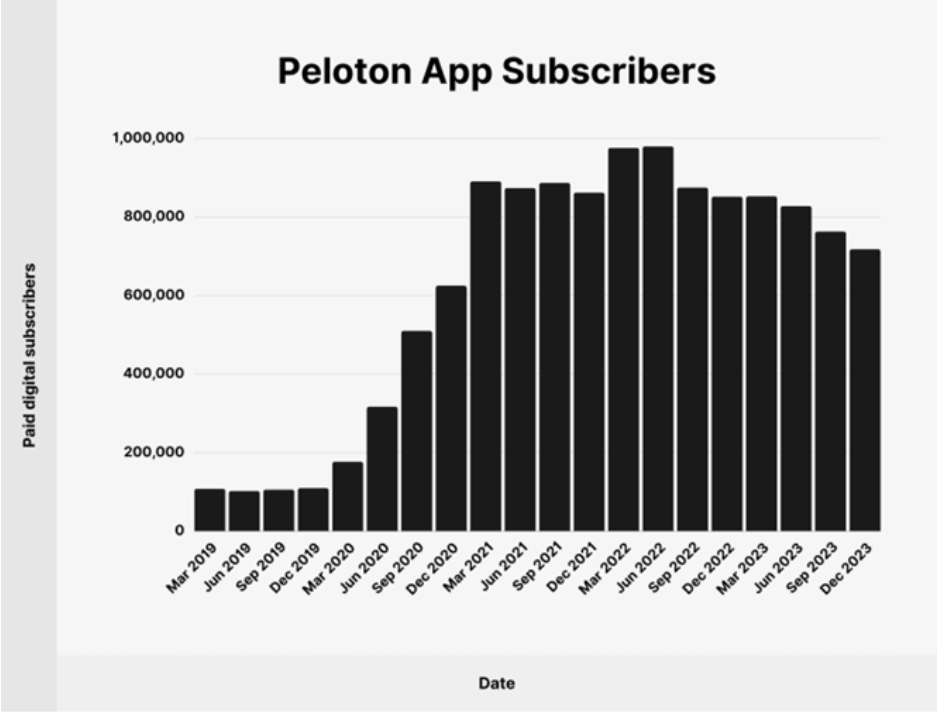
Under the hood, the mix told the same story. Subscriptions did about $1.67B; hardware did about $0.82B. Members closed FY25 at ~2.8M, averaging ~13 workouts/account/month. Monthly churn rose a touch (roughly 1.3% → 1.6% from FY23 to FY25), but subscription margins improved to ~69% gross and ~73% contribution. That combo — steady engagement, fatter unit margins, and real free cash flow — is what actually moved the stock.
Key debates
There are three plain-English questions people keep asking.
- Can churn hold around ~1.6% while hardware gets de-emphasized? Engagement says “probably,” because workouts/accounts are still healthy.
- Can EBITDA hold up without big top-line growth? The mix (more subscription) plus lower costs says “yes” — FY25 already printed ~$404M of adjusted EBITDA.
- Does the balance sheet cap the multiple? Gross debt is ~$2.0B, cash is ~$1.0B, so net debt is ~$0.94B; interest was ~$135M in FY25. Keep stacking positive FCF, and that interest bill gets lighter every quarter.
The inflection is less about a single catalyst and more about consistency. Peloton shifted from chasing units to monetizing habits. That shows up as repeatable cash flow, improving capital efficiency, and a cleaner cost base. The game now is not “grow at all costs,” it’s “stay boringly good.”
Outcomes
Turnaround is already in motion. New management shut loss-making retail, outsourced cardio manufacturing, and is cutting SG&A. Cash burn has flipped to positive free cash flow in recent quarters. Street models point to $400–500 million of EBITDA once cost rightsizing is finished. Give it a conservative 13× multiple, pay down half the $1.7 billion debt stack over three to four years, and you get ~$15 per share, a near-3× return, assuming zero top-line growth. Peloton Repowered (a resale marketplace) adds subscription conversions and takes a 15 percent fee that flows almost straight to EBITDA. Peloton has transformed from a volatile, hardware-driven business into a durable, profitable subscription model.
Base Case
This is the “keep doing exactly this” path. Connected Fitness subs hover around ~2.8M, churn stays near ~1.6%, subscription margins hold high-60s to low-70s, and the leaner opex sticks. That supports ~$400M of EBITDA, ongoing free cash flow, and net debt stepping down quarter after quarter. It’s not flashy; it’s the slow rerate that happens when a company keeps delivering boring, clean quarters.
Bull Case
No heroics required. Engagement inches up, Peloton Repowered (the resale marketplace) widens the funnel and takes a ~15% fee that’s almost pure EBITDA, and operating discipline pushes EBITDA toward $450–$500M. With each positive FCF quarter, net debt falls and the ~$135M interest drag eases. The multiple follows that math — without needing a hardware comeback.
Bear Case
The risks are common sense. Apple Fitness+ and cheaper spin clones chip at engagement, or a product safety wobble spooks users. Churn drifts up, margins flatten, and cost saves slip. EBITDA fades back toward the low-$300Ms, delever slows, and investors put PTON back in the “COVID relic” bucket. It’s less about one miss and more about losing the consistency of the story.
Evidence that points either way
For the bull/base, you already have receipts: subscription margin improvement to ~69%, opex down by $400M+ year-over-year, FCF swinging from –$470M to +$324M in two years, and Repowered launched to add conversion and near-pure EBITDA. For the bear, watch the habit signals: workouts/account dipping below ~13/month, faster erosion in the app-only tier, or any fresh quality/recall issues. If those crack, churn usually follows.
How the buy-side is modelling it
Guidance and “the Street” finally rhyme. FY25 closed around $2.46–$2.47B revenue, $330–$350M EBITDA, and ~$250M FCF. Early FY26 color points to $400–$450M of EBITDA and ~$200M of FCF. Most buy-siders are underwriting “steady, not sexy”: flat to slight growth, margins hold, debt glides down. The upside doesn’t require a surprise — it requires consistency. Every clean quarter forces estimate drift and rerating pressure in your favor.
Stage 3: Identifying Setup
Sentiment
PTON still sits in a lot of portfolios as a “busted COVID trade.” That under-ownership is the opening. Every clean quarter with positive free cash flow forces model updates and reluctant buying. The vibe is already shifting from “prove you’re not broken” to “show me two more FCF prints.”
Positioning
Peloton lives between tribes — too consumer for pure-software screens, too software-like for classic retail screens. Because it falls through those cracks, positioning isn’t crowded on either side. That means estimated drift (a little more EBITDA, a little less net debt) can move the stock more than people expect.
Catalysts
The checklist is intentionally boring. Keep free cash flow positive, quarter after quarter. Let Repowered scale so the ~15% marketplace fee drops almost straight to EBITDA and converts second-hand buyers into new subs. Walk net debt down from ~$0.94B, which lowers the ~$135M interest bill and gives room for content, bundles, and light ARPU tests once churn stays anchored. Avoid recall headlines, keep engagement around ~13 workouts/account/month, and the story compounds by itself.
Risk / reward
Use a practical multiple: ~13× EV/EBITDA and today’s ~$0.94B net debt.
- At $400M EBITDA: EV is $5.2B; equity is $4.26B. On 450–500M fully-diluted shares, that’s roughly $8.5–$9.5 per share.
- At $450M EBITDA: equity is $4.91B → $9.8–$10.9 per share.
- At $500M EBITDA: equity is $5.56B → $11.1–$12.4 per share.
As FCF pays net debt toward ~$0.5B, add roughly $0.9–$1.0 per share (the equity uplift from less debt spread over 450–500M shares). That’s your clean path from low-teens now to mid-teens — no hardware heroics required, just consistent execution.
Bottom Line
Peloton now sells a habit with software margins. Keep subs steady, keep cash flow boringly positive, chip away at debt, and this rerates on consistency, not on a miracle quarter. Two or three quiet, clean prints can do a lot of work.
References
- Ainvest. (2025, August 8). Peloton. Peloton profit turnaround sustainable rebound short term fix competitive market. Link
- Backlinko. (2025, April 14). Peloton Subscriber and Revenue Statistics (2024). Link
- Onepeloton. (2025, August 7). Investor OnePeloton. Link
- Onepeloton. (2025, September 22). The ultimate fitness experience. Link